
Physicians for Social Responsibility Pennsylvania told community members in Kline Township on March 2 that a single AI-generated email consumes an entire bottle of water. The claim, delivered by PSR PA Health Advocacy Outreach Coordinator Josephine Gingrich, had already been flagged as a factual inaccuracy in a formal correction request sent to the organization's leadership. PSR PA repeated it anyway.
The underlying research, a 2023 University of California, Riverside study, estimated that an AI chat session of roughly 20 to 50 queries uses up to 500 milliliters of water. That is one bottle spread across dozens of interactions, not one bottle per email. Independent estimates place the actual figure at roughly 1 to 3 milliliters per query. OpenAI CEO Sam Altman has publicly stated that an average ChatGPT query uses about one-fifteenth of a teaspoon.
PSR PA's version inflated the number by as much as 500 times.
The exaggeration matters because it feeds a broader narrative that treats AI water consumption as an existential resource crisis. Morgan Stanley projects that total global AI water consumption will reach approximately 1.07 trillion liters annually by 2028.
That number sounds enormous, until it meets basic context.
The United States alone withdraws roughly ~390 trillion liters of freshwater per year, according to the most recent U.S. Geological Survey data (2015). The entire projected global AI water footprint for 2028 amounts to less than three-tenths of one percent of the American water budget. Put differently, the U.S. uses more freshwater every nine hours than every AI system on Earth is projected to use in a year.
Agriculture accounts for 80 to 90% of all consumptive water use in the country, and the USDA reports that the average square mile of irrigated farmland uses approximately 1.2 billion liters per year. At that rate, roughly 900 square miles of farmland consumes as much water annually as every AI data center on the planet is projected to use by 2028.
The United States has approximately 83,000 square miles of irrigated farmland, and the global AI water footprint occupies about 1% of that equivalent area.
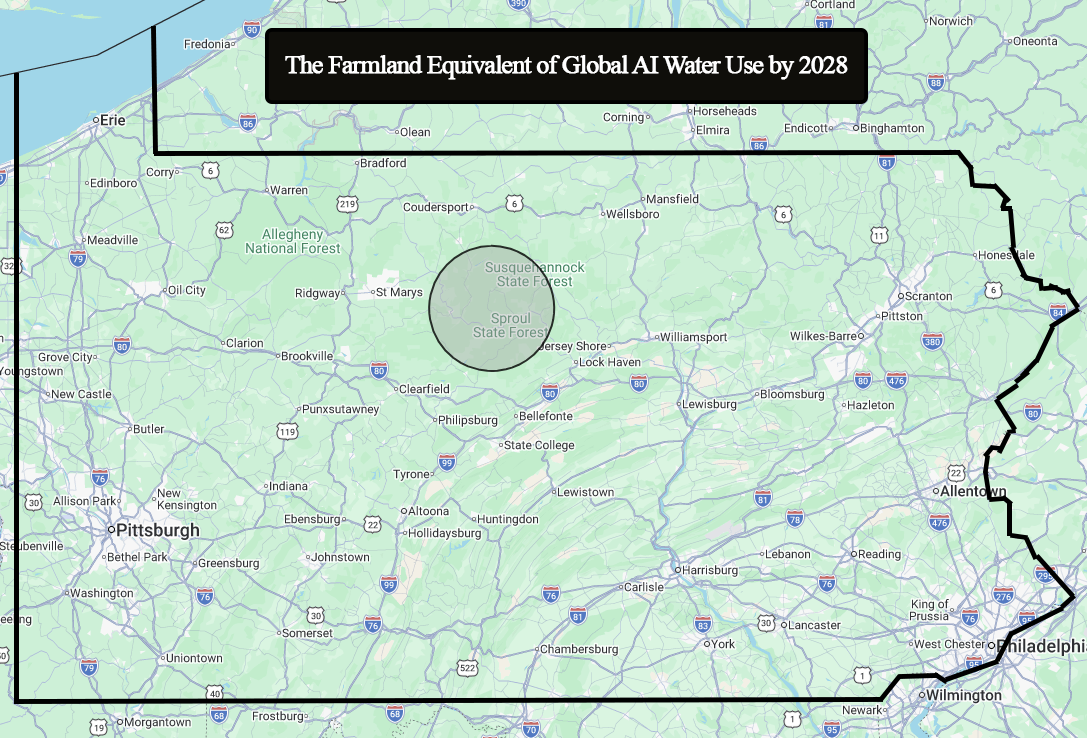
A thousand square miles is not trivial on a map. Centered on Pennsylvania, it covers a visible chunk of the state (2.2%). The real figure, 891.7 square miles of irrigated farmland, would demonstrate less. This represents the entire world's projected AI water demand, not a single state's or a single facility's.
For reference, this is how it looks from a higher vantage point.
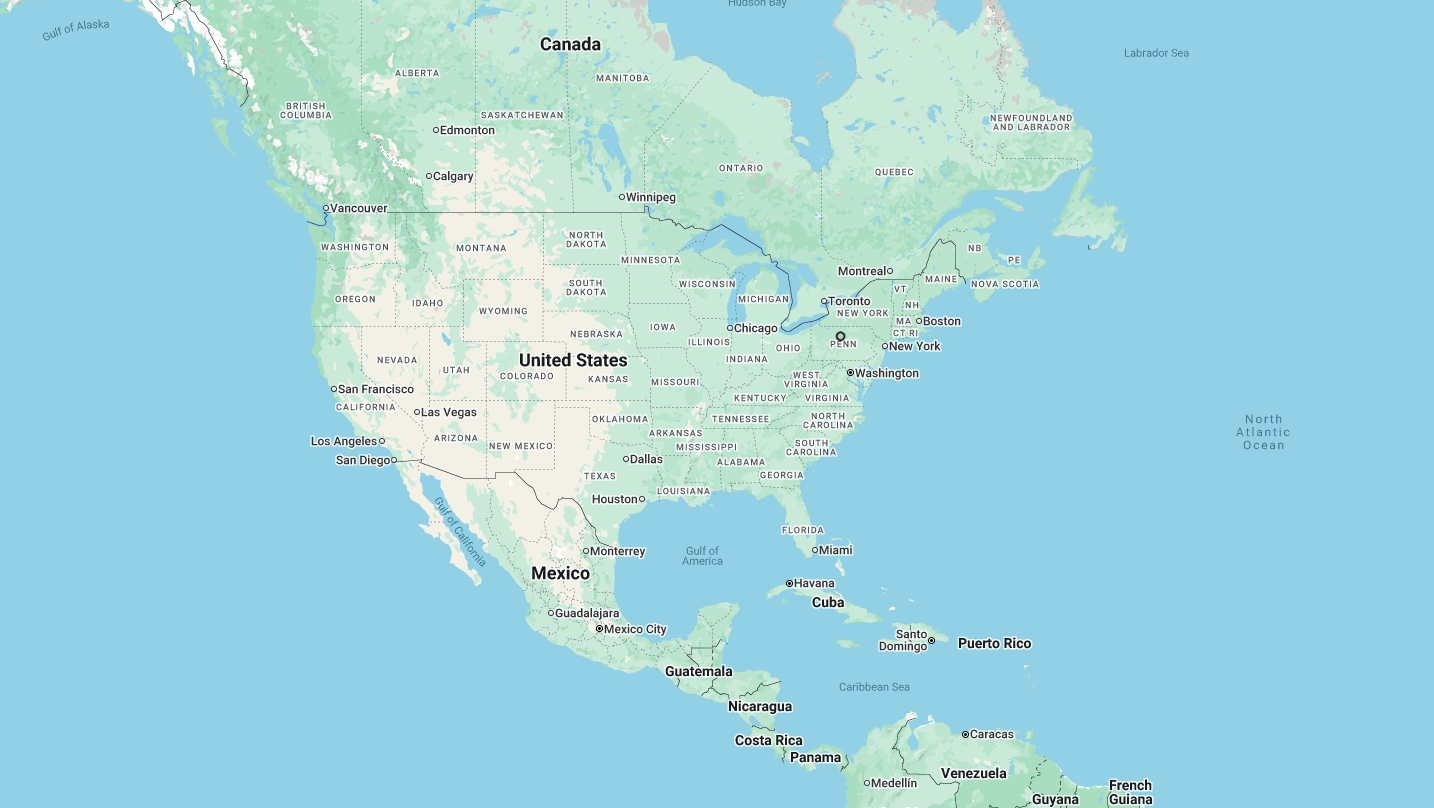
A thousand square miles of corn irrigation attracts no protest signs.
PSR PA's materials also told communities that data centers require potable water to operate, with less than 5% drawn from alternative sources. The 5% figure comes from the 2024 Lawrence Berkeley National Laboratory report, but PSR PA omitted the same report's findings on industry transition. Google reported in 2023 that 22% of its data center water came from reclaimed sources, and Equinix reported 25%. The industry trend is moving sharply away from potable water reliance, driven by both regulation and economics.
PSR PA did not offer communities the tools to address those local impacts. Their materials recommended opposition, not negotiation. They presented worst-case global projections as local certainties, inflated per-query figures by orders of magnitude, and omitted the industry data showing the trajectory of the problem they claimed to be describing.
The distinction between educating a community and mobilizing one is not about tone. It's about intent.
The future hangs in the balance.

