
A claim has been circulating at community meetings and in advocacy materials across Pennsylvania: a single AI-generated email consumes a full bottle of water.
The figure has appeared in infographics distributed by Physicians for Social Responsibility Pennsylvania in Luzerne County, repeated at public presentations in Schuylkill County, and cited in model ordinances drafted to restrict data center development. It is wrong by a factor of several hundred.
The source is a 2023 paper by Shaolei Ren and Pengfei Li at the University of California, Riverside. Their actual finding: a ChatGPT session of roughly 20 to 50 queries uses up to one 500-milliliter bottle of water, depending on when and where the servers are running. That is a session, not a single prompt.
The per-query figure works out to between 10 and 25 milliliters at worst case, and the researchers themselves noted their estimates vary by a factor of 30 depending on location, cooling technology, and model architecture.
Subsequent research has pushed the number lower. Independent academic estimates now place typical per-query water usage in the range of 1 to 5 milliliters, depending on model, location, and what counts as "indirect" consumption. In June 2025, OpenAI CEO Sam Altman disclosed that an average ChatGPT query consumes 0.000085 gallons of water, roughly 0.32 milliliters. Altman's figure accounts only for direct cooling and should be treated as a floor, not a ceiling. But even the highest credible independent estimate is one five-hundredth of a bottle.
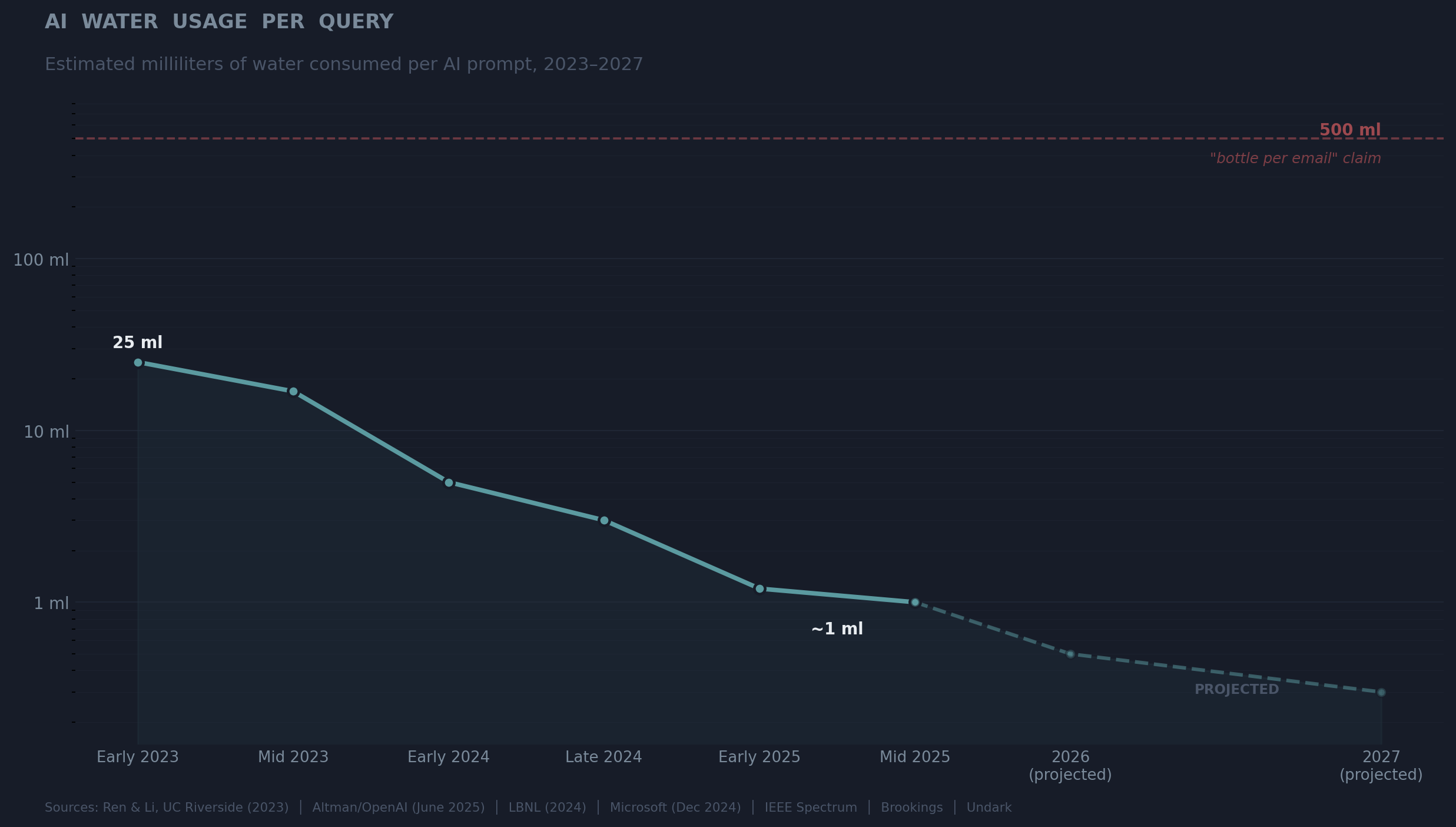
The trajectory is downward. AWS reported a 24% improvement in water usage effectiveness in a single year, reaching 0.19 liters per kilowatt-hour. Meta's newest facilities operate at 0.20 liters per kilowatt-hour. Microsoft announced in December 2024 that, starting that August, all new data center designs will use closed-loop, zero-water evaporation cooling, a design that eliminates more than 125 million liters of annual water consumption per facility. Pilots in Phoenix and Mt. Pleasant, Wisconsin, are expected to come online in 2026, with zero-water cooling becoming standard across new Microsoft builds by late 2027.
None of this means data center water use is trivial. The Lawrence Berkeley National Laboratory estimated 2023 U.S. data center water consumption at 17 billion gallons, and Google's water footprint rose 17% that year. Total consumption is rising because the number of facilities is rising.
The distinction that matters is between per-unit efficiency, which is improving, and aggregate demand, which is growing. Conflating the two distorts both.
The industry's sourcing mix is shifting as well. Google now uses reclaimed or non-potable water at more than 25% of its data center campuses. Equinix reported that 25% of its 2023 water use came from non-potable sources. The 2024 LBNL report found that stricter local regulations are accelerating the move toward alternative water sources and closed-loop systems. The current industry-wide average for non-potable sourcing sits below 5%, but the direction of the trend is relevant context that advocacy materials consistently omit.
The community meetings where these inflated figures circulate are not academic exercises. They shape zoning decisions, township ordinances, and public attitudes toward infrastructure that carries national security implications. When a presenter tells a room full of residents that sending an email drinks a bottle of water, and the actual peer-reviewed research says the figure is closer to a milliliter, the distortion is not a rounding error. It is misinformation deployed in service of a predetermined conclusion.
Residents evaluating data center proposals deserve accurate numbers. The real water figures are a legitimate subject for negotiation and regulatory oversight. The fabricated ones are not.

